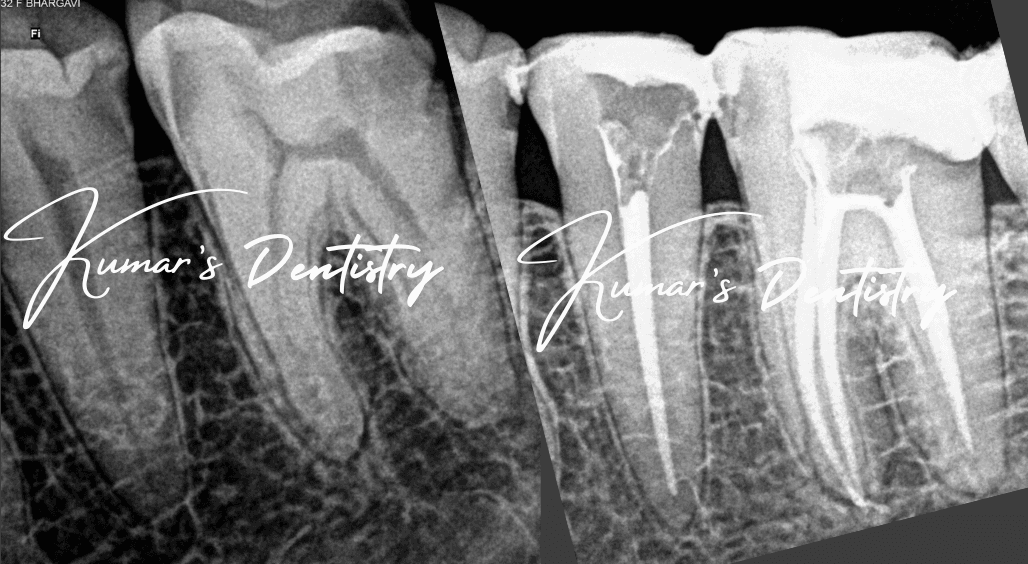
What is it?
Root canal treatment removes infected or inflamed pulp from inside a tooth, then cleans and seals the canal system so the natural tooth can be retained. At Kumar's Microscopic Dental Care on Attur Main Road, Yelahanka New Town, Dr. Prem Kumar R (MDS Pediatric & Preventive Dentistry; formerly Associate Professor at Ramaiah) performs many RCTs under microscopic magnification to improve visualisation of fine canals, calcified anatomy, and cracks.
Who needs it?
- Patients with deep decay reaching the pulp chamber
- Teeth with irreversible pulpitis, acute abscess, or lingering sensitivity
- Cracked or fractured teeth with pulp involvement
- Failed or incomplete prior root canals needing microscopic retreatment
- Teeth with decay developing under existing crowns or large fillings
Symptoms
- Spontaneous, throbbing, or lingering tooth pain
- Sharp pain on biting or extreme temperature sensitivity
- Swelling of gum or face near a tooth
- Discoloured tooth after trauma
- Pimple-like drainage on the gum (fistula)
Causes
- Deep dental caries reaching the nerve
- Dental trauma or hairline root fracture
- Large, deteriorating prior restorations
- Bacterial leakage under old crowns and fillings
- Cracks allowing bacterial ingress into the pulp chamber
Benefits
- Preserves the natural tooth whenever clinically feasible
- Relieves infection-related pain safely and quickly
- Microscopic magnification detects hidden, extra, or calcified canals
- Often completed in a single or few comfortable visits
Risks & considerations
- Instrument separation or canal ledge (minimized with microscopic protocol)
- Post-operative sensitivity for a few days
- Need for protective dental crown after RCT on posterior teeth
- Rare need for surgical endodontics if root tip healing is delayed
Treatment process
- Clinical exam, 3D digital imaging, and vitality pulp testing
- Painless local anaesthesia and rubber-dam isolation
- Microscopic access, cleaning, and biomechanical shaping under magnification
- Laser/ultrasonic disinfection and hermetic obturation (sealing) of canals
- Definitive core build-up and custom crown planning
Recovery
Mild tenderness for 1–3 days is normal. Soft diet, prescribed medicines if given, and avoiding biting hard foods until final crown placement. Contact us promptly if severe swelling develops.
Duration
Typically 45–90 minutes per visit; single-sitting RCT available for suitable non-abscessed cases.
Cost (Bangalore indicative)
₹4,000 – ₹12,000+ per tooth depending on tooth type (anterior vs molar) and complexity. Indicative Bangalore ranges; confirm at consultation.
Indicative Bangalore ranges for planning only. Final fees confirmed after clinical examination.
Success & outcomes
When canals are thoroughly disinfected under magnification and promptly sealed with a quality crown, tooth retention rates exceed 95% in clinical literature.
Frequently asked questions
Is microscopic RCT better than conventional root canal?
Yes. High-power magnification (up to 25x) and co-axial illumination allow Dr. Prem Kumar R to locate extra canals, narrow calcified roots, and micro-cracks that are completely invisible to the naked eye.
Can a root canal be done on a tooth that already has a crown?
Yes. We can access the pulp chamber directly through a precision window in the crown or remove the old crown if there is recurrent decay underneath, treat the root canal, and place a fresh crown.
Is root canal treatment painful?
No. Modern computerized local anesthesia ensures the entire procedure is comfortable and pain-free. Most patients report immediate relief from their throbbing toothache.
Is root canal safe during pregnancy?
Yes. Emergency dental care and root canal treatments are safe during pregnancy, especially during the second trimester, using pregnancy-safe local anesthetics and protective lead aprons.
Will I need a crown after a root canal?
For premolars and molars (back teeth), a dental crown is strongly recommended to protect the brittle tooth structure from biting fractures. Dr. RV Roshini, MDS Prosthodontist, designs precision zirconia or ceramic crowns.
Related treatments
Medically reviewed by Dr. Prem Kumar R, MDS (Pediatric & Preventive Dentistry). Last updated 2026-08-30. Educational references include publicly available guidance from organisations such as the Indian Dental Association (IDA) and American Dental Association (ADA) patient education materials—adapted for general understanding, not as case-specific advice.